
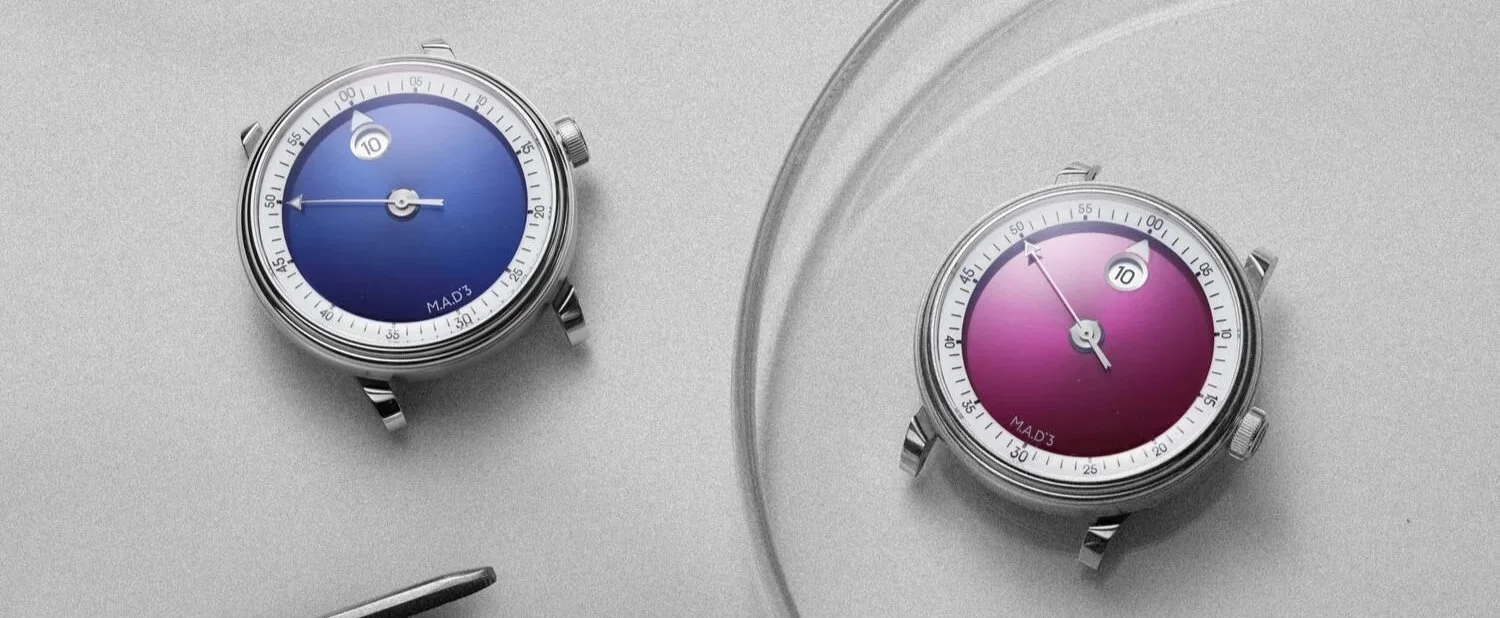
MB&F’s M.A.D.Editions has always had a mischievous streak. These are watches built around movement, colour and a healthy disregard for convention. The new M.A.D.3 continues that tradition, although this time the inspiration comes from one of independent watchmaking’s great creative troublemakers, Vincent Calabrese.
At 82 years old, Calabrese remains every bit the horological maverick. Over a career spanning more than five decades, he has accumulated over 40 patents, co-founded the Académie Horlogère des Créateurs Indépendants and created the movement architecture that eventually became the Corum Golden Bridge.
He once described himself as “l’enquiquineur de l’horlogerie”, or the troublemaker of watchmaking. That alone makes him a natural fit for M.A.D.Editions.
For the M.A.D.3, Maximilian Büsser and his team have revisited Calabrese’s Baladin concept, an unusual wandering-hour complication designed to make the transition between hours feel more natural.
The result is a watch that does not simply tell the time. It lets the hour take the scenic route.
A jumping hour that does not really jump
Calabrese was never satisfied with the abrupt action of a conventional jumping hour. The display remains static for most of the hour before suddenly snapping to the next numeral. Technically impressive, perhaps, but not especially representative of the way time actually passes.
His Baladin offered a different approach. Rather than changing instantaneously, the hour indication progresses around the dial and gradually rotates into the next numeral as it approaches the top of the hour.
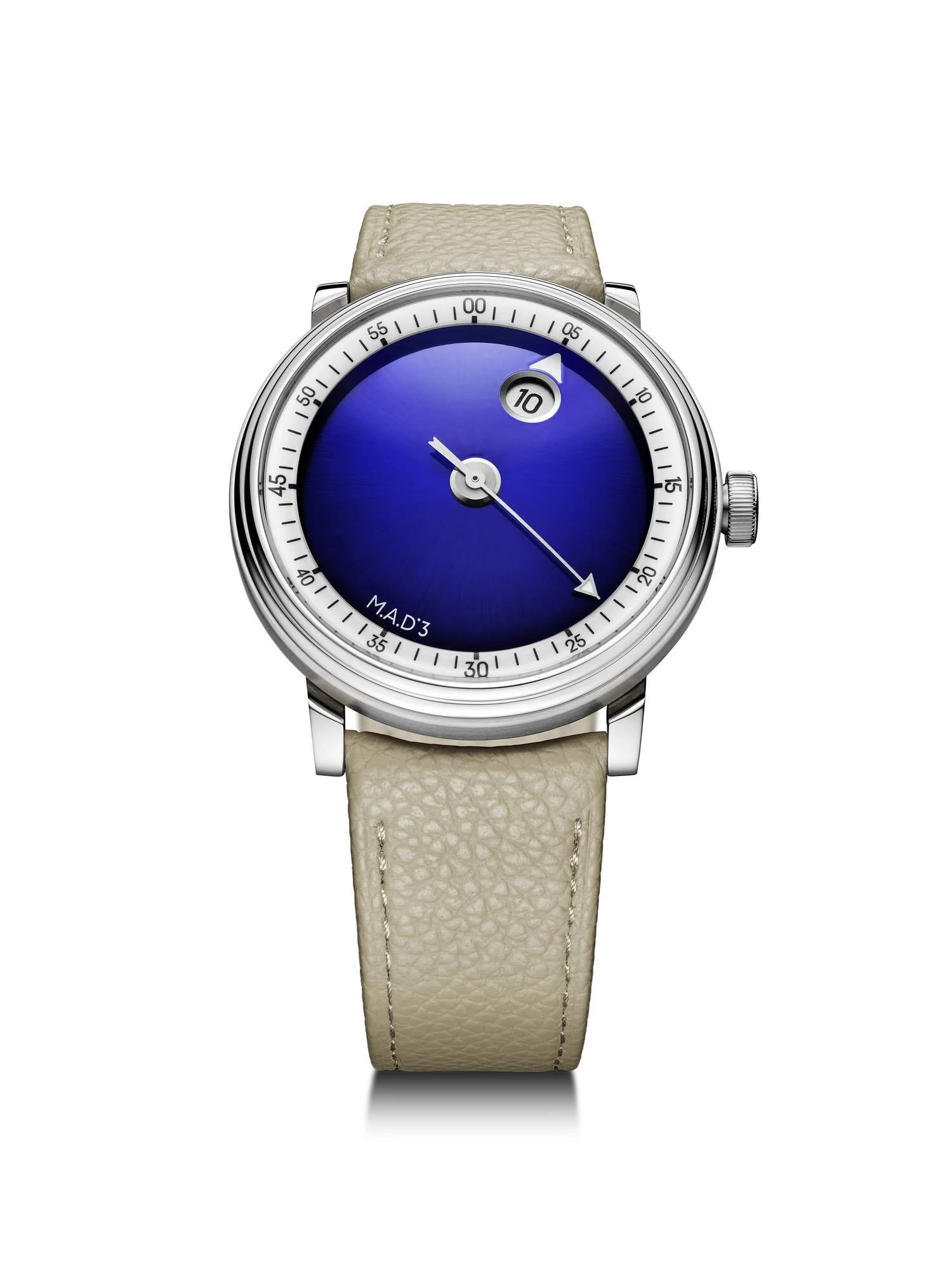
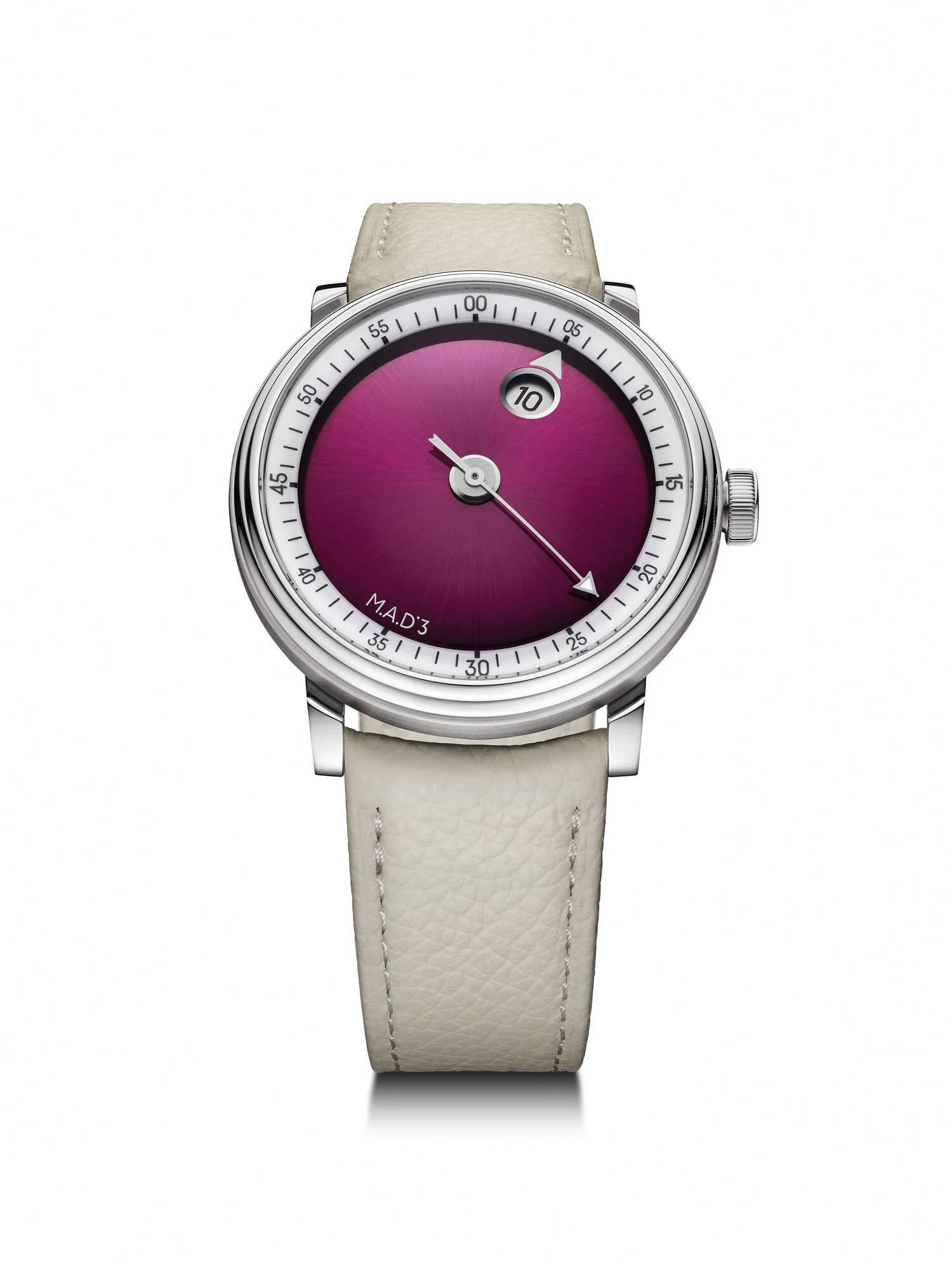
The M.A.D.3 retains that wandering transition but places it within a completely new design.
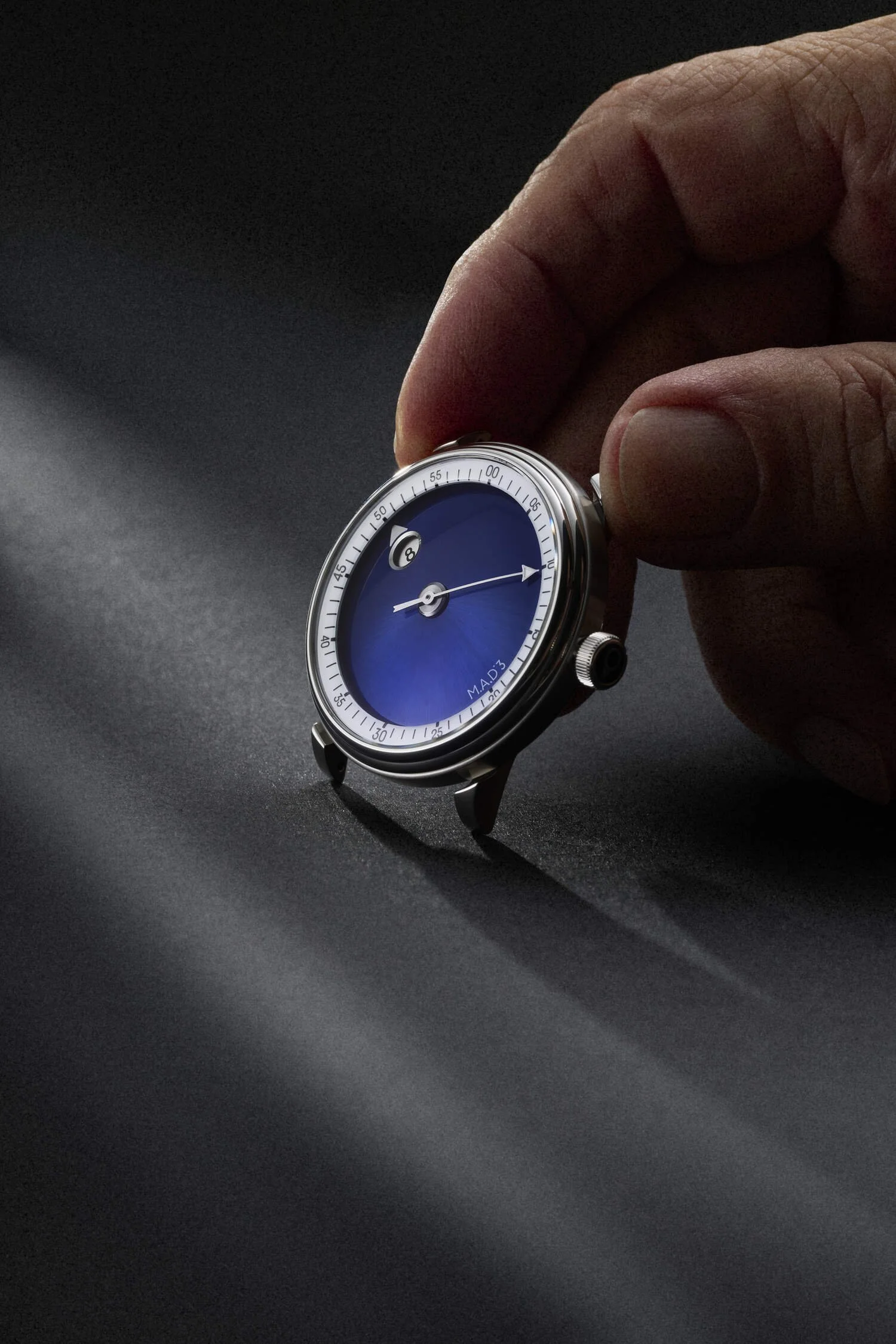
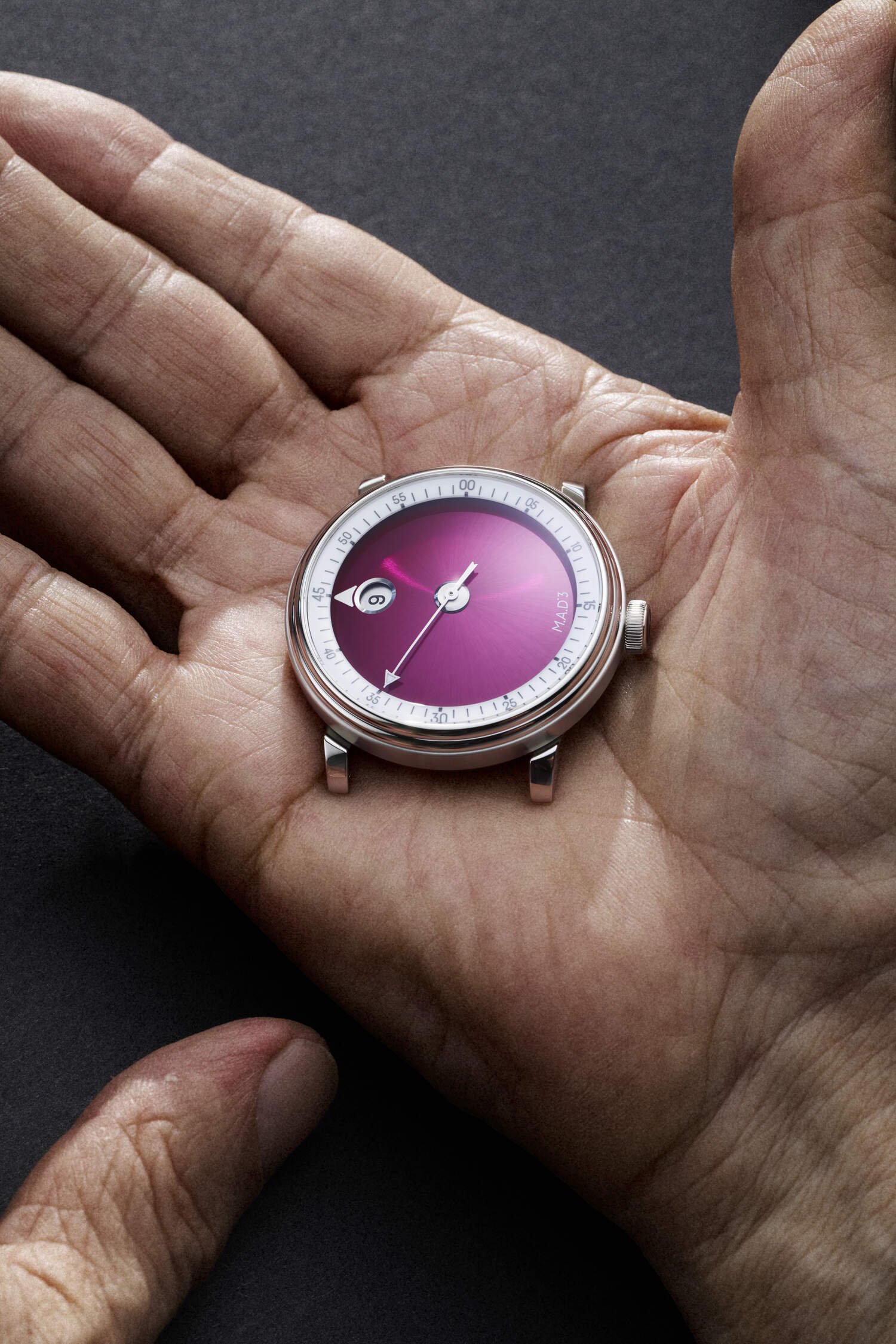
A blue sunray disc rotates beneath a large central seconds hand. A triangular pointer on the disc indicates the minutes against a white sapphire scale, while an aperture beneath it displays the hour. As the disc travels around the dial, the hour numeral slowly turns over.
It appears complicated at first glance, although early hands-on reports suggest it becomes intuitive surprisingly quickly.
There is also always something happening. Conventional jump-hour watches can be rather uneventful for 59 minutes, whereas the M.A.D.3’s rotating dial creates a constant sense of motion. It is not perfect, though. As the numeral rotates with the dial, six and nine can become difficult to distinguish when viewed upside down.
Whether this proves irritating in everyday use remains to be seen. Unusual displays nearly always demand a small adjustment from the wearer, and the M.A.D.3 is hardly pretending to be a model of conventional legibility.
Smaller, but not necessarily slimmer
Longtime MB&F collaborator Eric Giroud designed the stainless steel case. It measures 40mm across, 12.7mm thick and 43.7mm from lug to lug.
That short overall length is achieved through floating lugs integrated into the caseback. Despite measuring nearly 13mm thick, the watch should sit comfortably on a wide range of wrists.

The case mixes polished and brushed surfaces with a stepped bezel and sapphire crystals front and back. Water resistance is rated at 30 metres, so this is one for admiring beside the pool rather than testing in it.
Compared with the M.A.D.1 and M.A.D.2, the new watch has a more traditional appearance. There is a recognisable dial, a central seconds hand and a case that looks surprisingly restrained by M.A.D.Editions standards.
Look a little closer, however, and normality quickly wanders off.
The blue sunray disc, white bombé sapphire minute track and boldly shaped indicators give the dial considerable depth. Yellow and red accents provide the necessary playfulness, while the beige leather strap prevents the whole thing from becoming too loud.
The nighttime display should be equally entertaining. The peripheral minute track glows blue, while the seconds hand, minute pointer and hour indication emit green light. It is a thoughtful detail that reinforces the M.A.D.3’s mechanical theatre after dark.
Rebuilding the Baladin
The original Baladin mechanisms were handcrafted, highly artisanal constructions. They were inventive and full of character but never designed to be manufactured in four-figure quantities.
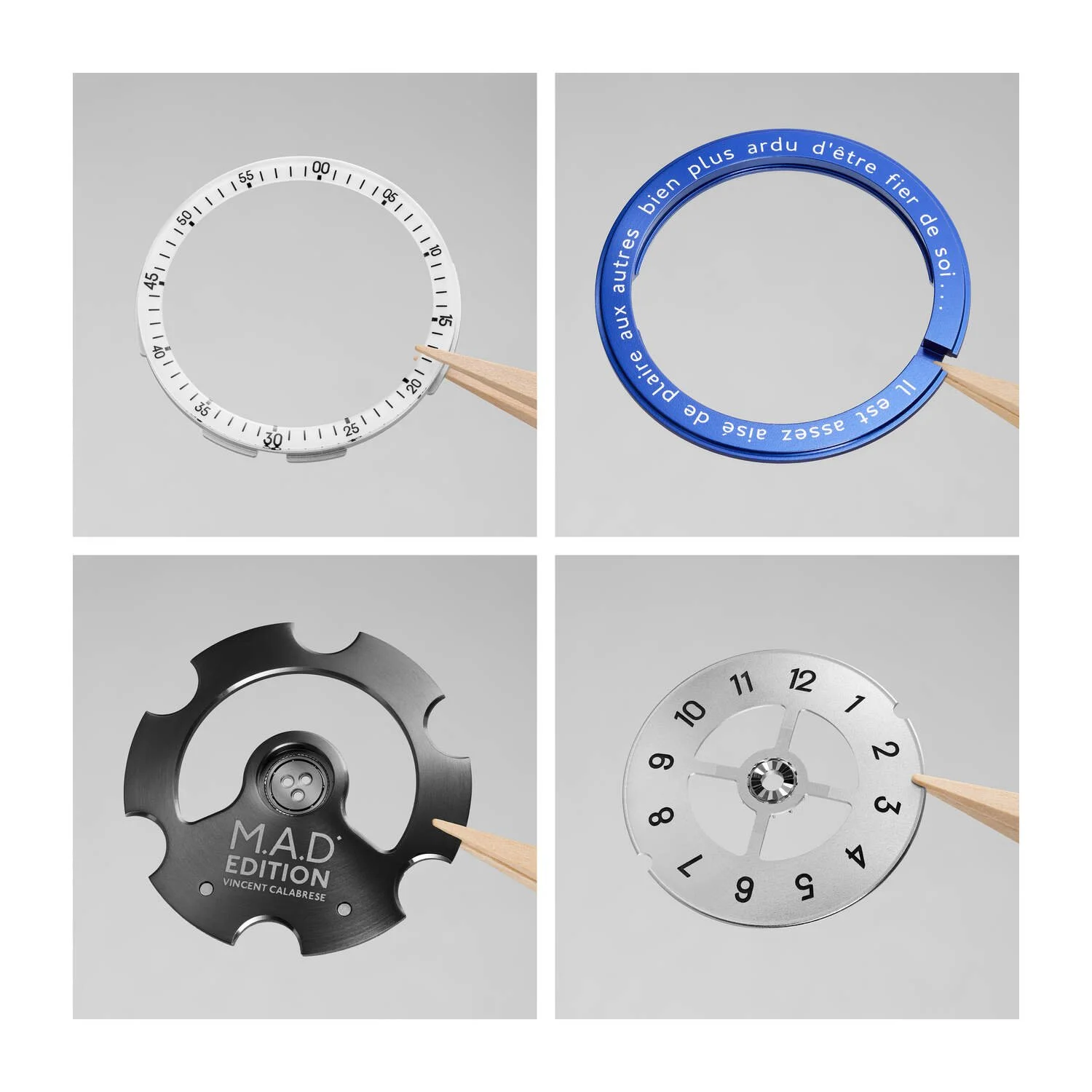
MB&F therefore had to redevelop the complication from the ground up.
The new module sits above a Swiss-made La Joux-Perret G111 automatic calibre. The base movement was refined with tighter tolerances and improved amplitude control to handle the complication’s energy requirements. MB&F also developed new components to improve energy transmission, reliability and long-term stability.
The finished movement runs at 28,800 vibrations per hour, contains 24 jewels and provides a 55-hour power reserve.
It is an important part of the M.A.D.3 story. This is not simply a familiar movement hidden behind a clever dial. Considerable work was required to transform Calabrese’s handcrafted concept into something capable of larger production without losing the slow, hypnotic transition that made it special.
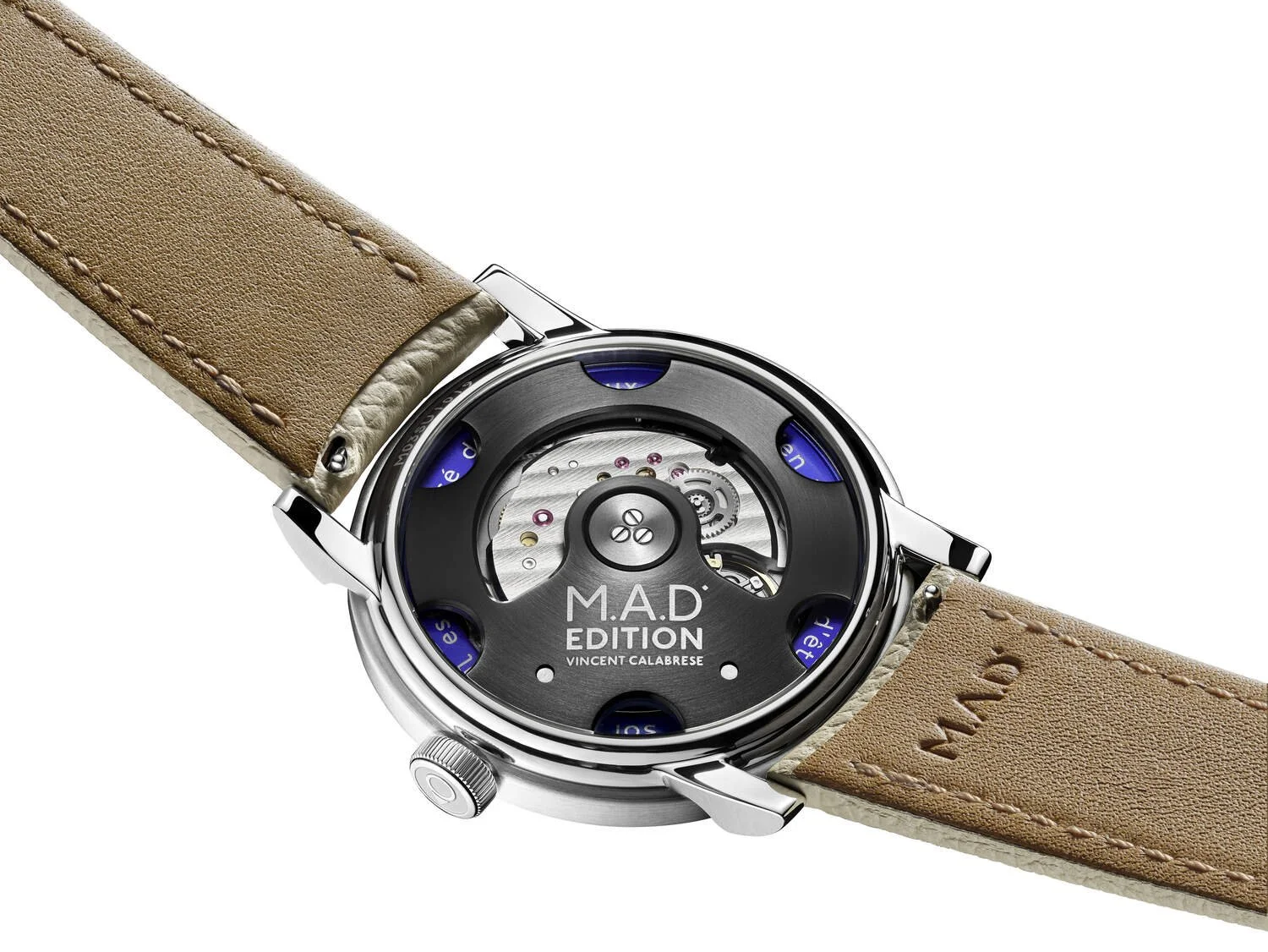
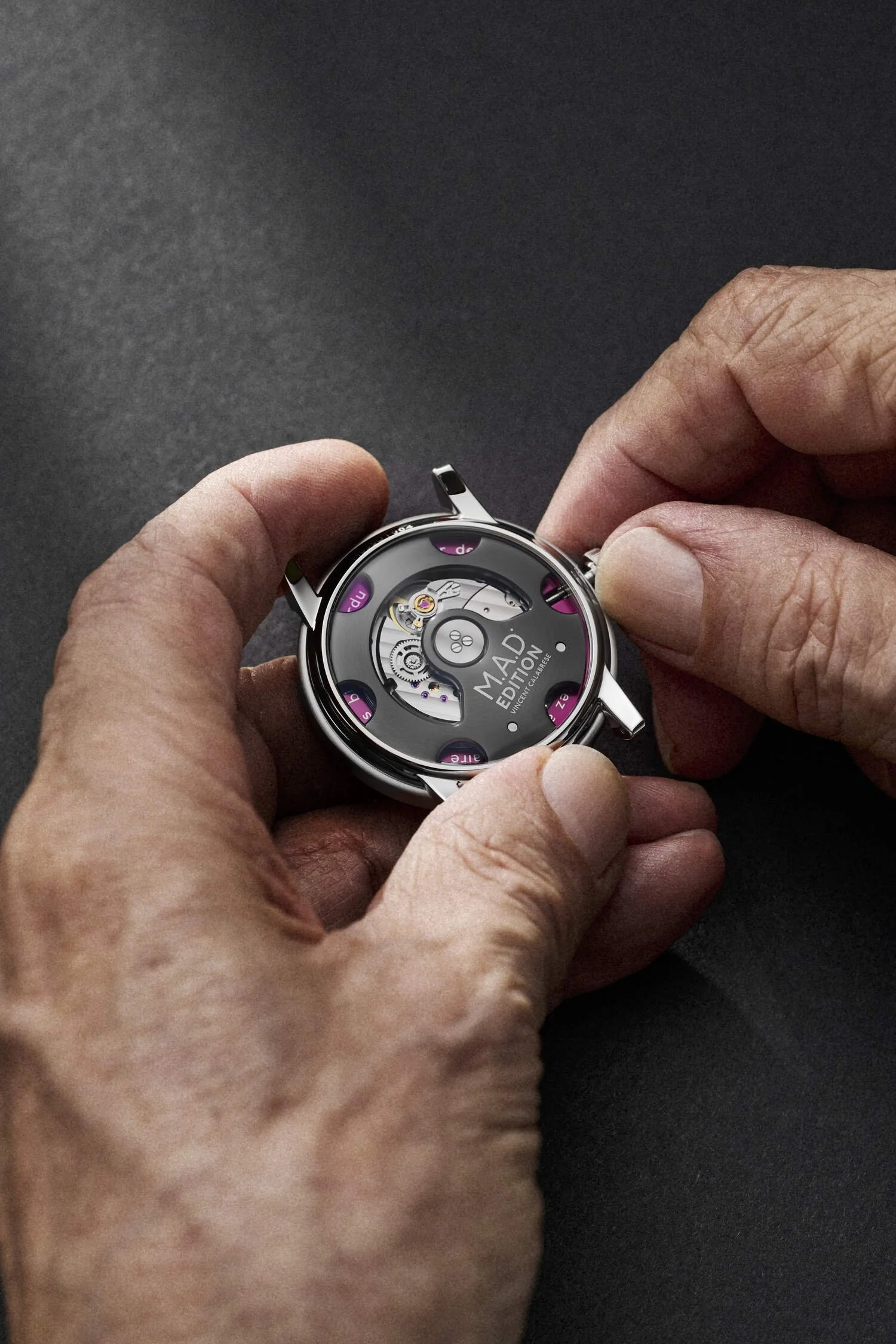
Turn the watch over and the automatic rotor delivers another piece of theatre. Six openings gradually reveal the French inscription:
“Il est assez aisé de plaire aux autres, bien plus ardu d’être fier de soi.” Translated, it reads: “It is fairly easy to please others, far more difficult to be proud of oneself.”
It is a fitting summary of Calabrese’s career. He has spent decades following his own instincts, frequently at considerable personal and financial cost.
Price and availability
Two versions of the M.A.D.3 are being offered. The pink model is reserved for MB&F’s Tribe and Friends, while the blue edition is available through the public raffle.
Approximately 1,500 blue watches will be allocated, although the M.A.D.3 is not described as a formally numbered limited edition. The price is CHF 2,900 excluding VAT.
Registration is open until 7 September 2026 at 3:00pm CEST, with the draw taking place on 8 September. Successful entrants will be charged automatically, while unsuccessful participants will have their payment authorisation released.
Previous unsuccessful entrants receive a double chance if they register using the same email address. Deliveries are expected between October 2026 and April 2027.
Watch Brothers Thoughts
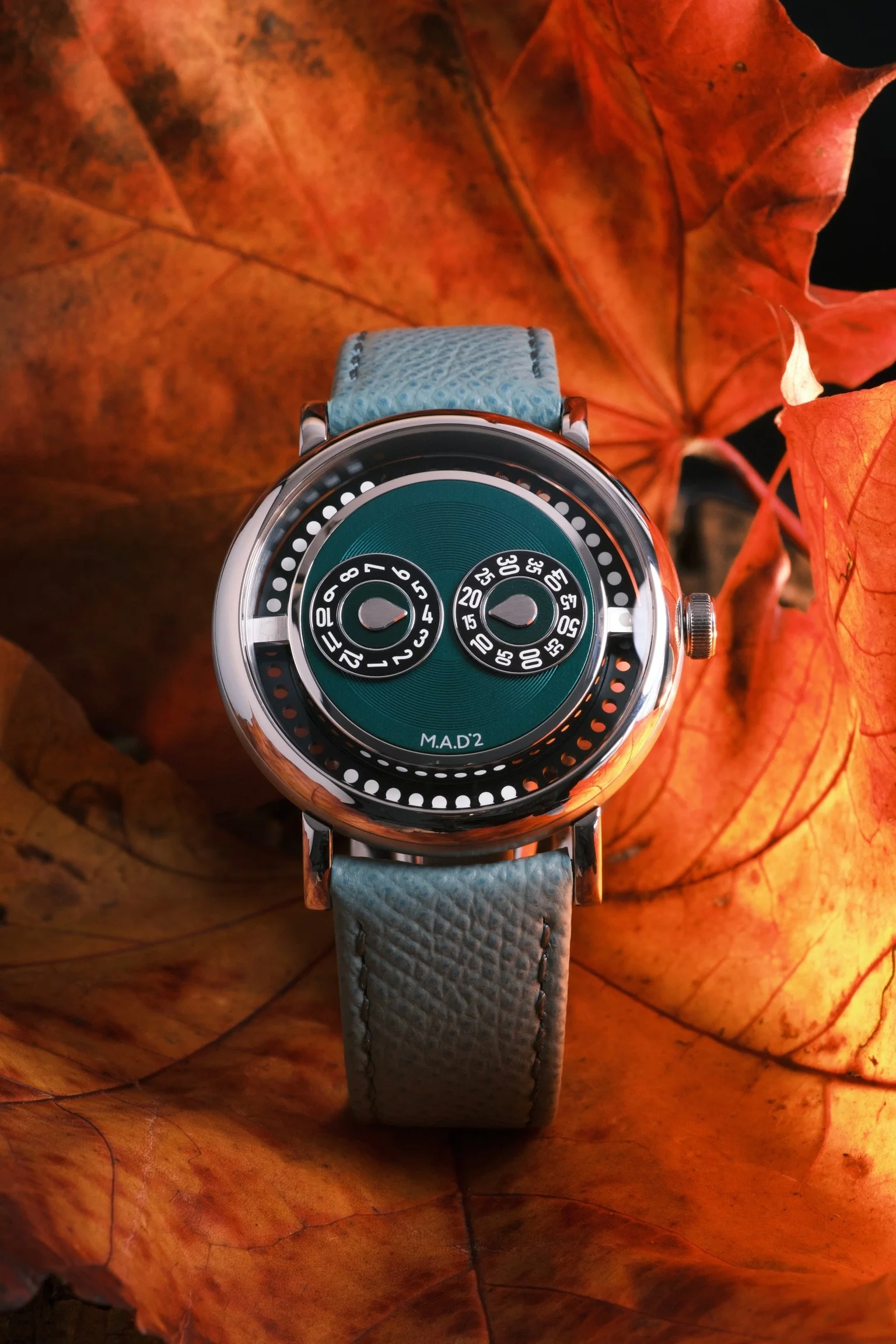
As the owner of a green M.A.D.2, the M.A.D.3 presents me with something of a problem.
When I reviewed the M.A.D.2, I said it had probably scratched my MB&F itch. After two unsuccessful raffle attempts, I had finally managed to get one with some help from Robb Nudds, and it felt like the right M.A.D.Editions watch for me.
The M.A.D.1 had never quite clicked. It was clever and unmistakably MB&F, but I found it a little too bulky. The M.A.D.2 fixed much of that. It was sleeker, easier to wear and wrapped its mechanical trickery in a design inspired by turntables and 1990s club culture.
The M.A.D.3 now takes things in a noticeably different direction.
At 40mm, it is 2mm smaller than the M.A.D.2, while its 43.7mm lug-to-lug measurement is considerably shorter than the M.A.D.2’s 48.5mm. The M.A.D.3 is fractionally thicker at 12.7mm compared with 12.3mm, although its floating lugs should make it feel more compact on the wrist.
The difference is not simply about dimensions.
The M.A.D.2 is all about rhythm and spectacle. Its dial resembles a pair of raised turntables, while the large front-mounted rotor spins like a vinyl record whenever you give the wrist a flick. It is playful, energetic and occasionally a little ridiculous, which is precisely why I enjoy owning it.
The M.A.D.3 feels more grown-up. The round case, central seconds hand and leather strap give it a more conventional silhouette. Its eccentricity is concentrated within the wandering-hour display rather than shouted through the entire watch.
That may make it more versatile than the M.A.D.2, but perhaps less immediately theatrical.
Legibility is another interesting comparison. The small hour and minute indicators on my M.A.D.2 require decent eyesight. It is not a watch you glance at from the corner of your eye. The M.A.D.3’s larger minute track and prominent pointer should make the minutes easier to read, although the wandering hour introduces its own learning curve and the rotating six and nine may cause some confusion.
The movement specification also produces an unexpected result. My M.A.D.2 uses the La Joux-Perret G101 and offers a 64-hour power reserve. The M.A.D.3 moves to the G111 but drops to 55 hours, presumably due to the additional demands of its redesigned wandering-hour module.
On paper, then, the M.A.D.3 is not an upgrade in every measurable sense. It is smaller and potentially easier to read, but slightly thicker and equipped with a shorter power reserve.
Where it does move forward is in its horological story. The M.A.D.2 celebrates Giroud, music and the joy of movement. The M.A.D.3 connects directly with Vincent Calabrese and an important chapter in independent watchmaking. There is more history behind the display and arguably more mechanical substance beneath it.
Would I trade my M.A.D.2 for one? No.
The M.A.D.2 has a confidence and energy that suits me. I love its connection to club culture, its spinning rotor and the fact that it never takes itself too seriously. It also has the advantage of already being on my wrist rather than sitting at the mercy of another raffle.
Would I like to own both? That is a rather more dangerous question.
The M.A.D.3 appears more refined, compact and mechanically fascinating. It may even be the best all-round M.A.D.Editions watch so far. Yet the M.A.D.2 remains the more visually distinctive of the pair and, for me, the more emotionally engaging.
Perhaps the real appeal is that neither watch makes the other redundant. They share a price, a designer and a fondness for unconventional time displays, but their personalities are entirely different.
The M.A.D.2 turns the volume up, the M.A.D.3 takes its own path, and unfortunately for my bank balance, I can see the attraction of both.